
Most investors have at least some sense of what their investments are earning. Far fewer can say with confidence whether those investments are on track to fund the things that actually matter to them - a child's education in ten years, a retirement in twenty, or a property purchase somewhere in between.
That gap between portfolio performance and goal progress is the problem a goal-based allocation framework is designed to close. Benchmark returns tell you how a portfolio performed against a market index. They do not tell you whether the money you have today will become the money you need by the time your goals arrive.
This article explains how a goal-linked approach works, how it differs from benchmark-led thinking, and how Cambridge Wealth's Goal-Linked Approach process helps you organise multiple goals within a structured asset-allocation framework.
Key Takeaways
- A goal-linked approach measures progress against specific life milestones, not market benchmarks
- Different goals have different timelines, funding requirements, and asset-allocation considerations
- Scheme and product evaluation matters: identifying an asset class is only part of the work
- Goals require active monitoring - timelines, costs, and circumstances change
- Managing multiple goals with competing demands on the same investible surplus requires structured prioritisation
What Goal-Linked Approach Means
Goal-Linked Approach is the process of connecting investment decisions to specific, defined life objectives - each with a timeline, a funding requirement, and an appropriate asset-allocation context.
For Cambridge Wealth, Goal-Linked Approach means organising relevant scheme and product information around the goals, timelines, liquidity requirements, and risk considerations you identify. This gives each investment decision a defined context rather than treating products or market returns in isolation.
The core idea is straightforward: rather than asking "what is the market doing?", the goal-linked question is "what does this money need to achieve, and by when?" Progress is measured against the goal - not against an index.
This matters most when you are managing several goals simultaneously. Retirement, a child's overseas education, and a home purchase may all be active at the same time, each with a different timeline, a different funding requirement, and a different risk consideration. Managing them as a single undifferentiated portfolio makes it difficult to know whether any individual goal is on track.
Goal-Linked vs. Benchmark-Led Thinking
The distinction between a goal-linked approach and a benchmark-led one is not just philosophical - it affects how you evaluate progress, manage risk, and respond to market volatility.
| Dimension | Benchmark-Led Approach | Goal-Linked Approach |
|---|---|---|
| Progress measure | Portfolio return vs. index | Progress toward each specific goal |
| Portfolio structure | Single unified portfolio | Allocation context mapped to individual goals |
| Risk definition | Volatility / standard deviation | Probability of falling short of a goal's funding requirement |
| Review trigger | Market movement | Change in goal cost, timeline, or circumstances |
| Emotional anchor | Market performance | Life milestones |
Goal risk is not the same as portfolio volatility. It is the possibility that a particular goal will be underfunded by the time it arrives. That framing changes the questions you should be asking - and changes how Cambridge Wealth structures the scheme information it provides.
At Cambridge Wealth, goal-linked approach begins by mapping each stated objective into a documented framework covering timeline, approximate funding requirement, and liquidity profile - so that the scheme information shared reflects what each goal actually needs.
How the Goal-Linked Framework Works
Step 1: Define and Prioritise Goals
The starting point is a clear inventory of what you are trying to achieve. Goals vary widely in their importance, their time sensitivity, and the consequences of falling short.
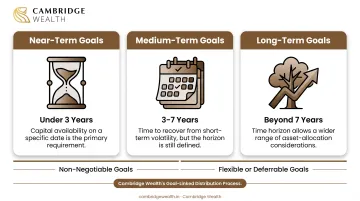
A useful organising structure is timeline:
- Near-term goals (under 3 years): where capital availability on a specific date is the primary requirement
- Medium-term goals (3-7 years): where there is some time to recover from short-term volatility, but the horizon is still defined
- Long-term goals (beyond 7 years): where time horizon allows a wider range of asset-allocation considerations
Prioritisation matters when the investible surplus is not sufficient to fund every goal simultaneously. Some goals are non-negotiable (retirement); others can be scaled or deferred. Some have hard deadlines; others have flexibility. Cambridge Wealth's Goal-Linked Approach process helps organise these objectives into a structured hierarchy, so that the scheme information and product selection that follows is grounded in explicit priorities rather than general preference.
Step 2: Establish Timeline and Funding Requirement
Once goals are listed and prioritised, each needs a funding estimate - not what it costs today, but what it will cost when it arrives. Inflation compounds differently across different goal categories. The cost of higher education does not move in the same way as general consumer prices, and real estate costs in a target city may follow a different trajectory again.
The practical task here is establishing a realistic target figure for each goal, grounded in current reference data and a reasonable view of how that cost is likely to move over time. This is the groundwork that underpins every subsequent allocation and product decision - without it, a framework has no anchor.
Cambridge Wealth handles this estimation as part of the Goal-Linked Approach process, working from publicly available data (including MoSPI's CPI releases for general inflation reference) and the specific characteristics of each goal.
Step 3: Understand Existing Financial Commitments and Resources
A goal-linked framework does not operate in isolation. Every investor has existing commitments - loan repayments, insurance premiums, dependant expenses - alongside existing assets, investments, and liquidity buffers. Both sides of the picture matter.
The objective of this step is to establish how much can realistically be directed toward each goal, after accounting for existing commitments and an appropriate liquidity reserve. Overcommitting to long-term goals while leaving near-term obligations underfunded creates fragility. This assessment gives the framework realistic inputs rather than aspirational ones.
Cambridge Wealth reviews existing assets, liabilities, and cash flows together with stated goals, so that scheme selection and contribution levels are grounded in what is actually achievable.
Step 4: Establish Asset-Allocation Context
With goal priorities, funding requirements, and available resources understood, the next step is establishing an asset-allocation context for each goal - the broad approach to how contributions should be invested, given the goal's timeline and risk profile.
The general principle is that the investment approach should reflect the time available to reach the goal and the consequences of falling short. A goal that must be funded in two years has different asset-allocation considerations than one with a fifteen-year runway. The longer the horizon, the wider the range of investment categories that can be considered; the shorter the horizon, the greater the emphasis on capital availability over growth potential.
This is a framework for thinking about asset-allocation context - not a fixed allocation rule. The right approach for any individual depends on their complete financial situation, risk tolerance, and the specific characteristics of each goal. It is also not static: as goals draw closer or circumstances change, the appropriate asset-allocation context shifts.
Step 5: Identify and Implement Relevant Investment Products
The final step is moving from asset-allocation context to specific investment products and implementation. This is where Cambridge Wealth's Goal-Linked Approach process brings structure to what can otherwise be a fragmented search.
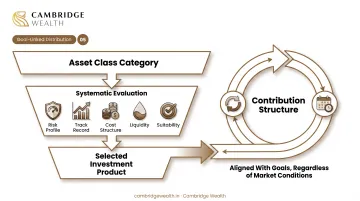
Identifying an appropriate asset class or scheme category is only the beginning. Within any given category, there is a significant range of available options - varying in risk profile, track record, cost structure, liquidity, and suitability for different goals. Selecting from that range requires systematic evaluation, not just a search for the highest recent return.
Implementation also means establishing contribution structures that keep the framework running consistently over time - so that contributions continue aligned with goals regardless of short-term market conditions.
How Timeline Affects Investment-Product Considerations
A goal's time horizon is one of the most significant inputs into any asset-allocation decision. It does not dictate a fixed product choice, but it does shape what is worth considering and what is not.
For near-term goals, where capital needs to be available on a specific date within a short window, the primary consideration is that the money is accessible when required. Market-linked instruments at short horizons carry meaningful volatility relative to the goal's timeline - a drawdown in the months before a goal arrives can have real consequences.
For medium-term goals, there is more time to accommodate market fluctuations, but the horizon is still defined enough to require a balance between growth potential and capital protection. The appropriate product range broadens, but the need for alignment with the specific timeline and risk tolerance remains.
For long-term goals, the time horizon allows a wider range of asset-allocation considerations, including equity-oriented categories where growth potential over long periods is a relevant factor. The longer the horizon, the less any single year's market performance tends to determine the outcome. However, a long horizon is not a reason to ignore alignment or monitoring - circumstances, timelines, and funding requirements change, and the appropriate product mix should be reviewed accordingly.
The key point in all cases is that the selection of investment products should be driven by what the goal actually requires - not by what is performing well at the time of investment.
Why Scheme Evaluation Matters
Identifying a suitable asset-allocation context is the framework; evaluating available investment products within that context is the execution. The two are not the same thing, and conflating them is one of the reasons goal-linked frameworks break down in practice.
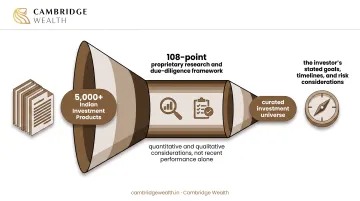
Cambridge Wealth evaluates 5,000+ Indian investment products through a 108-point proprietary research and due-diligence framework, using quantitative and qualitative considerations rather than relying on recent performance alone. Within a goal-linked framework, this research process helps narrow the available investment universe to options that can then be considered in the context of your stated goals, timelines, and risk considerations.
Monitoring and Reviewing Goal Alignment
A goal-linked framework is not a one-time exercise. Goals change. Timelines shift. The cost of reaching a goal in ten years looks different as that date draws closer. New goals emerge; existing ones are reprioritised.
The review process in Cambridge Wealth's investment model focuses on whether investment-product selections remain aligned with each goal's current timeline, funding requirement, and risk profile - not merely on whether markets have moved up or down.
Events that warrant a review outside the regular schedule include:
- A significant change in income (upward or downward)
- A major life event: marriage, children, change in dependants, inheritance
- A change in a goal's timeline or cost estimate
- An existing investment earmarked for one goal being considered for another purpose
- A change in residency status (particularly relevant for NRI investors)
Portfolio realignment - adjusting the investment mix when it has drifted from the intended asset-allocation context - is a decision for you. Cambridge Wealth can support this process by providing relevant scheme information and helping you understand how a weightage adjustment may affect the goal-linked framework.
The important discipline is that reviews are goal-driven, not market-driven. The question is not "what should I do because the market fell?"; it is "are my goals still adequately funded at their current timelines?"
Practical Mistakes That Break Goal Alignment
Even a well-structured goal-linked framework can break down in practice. The following mistakes are common:
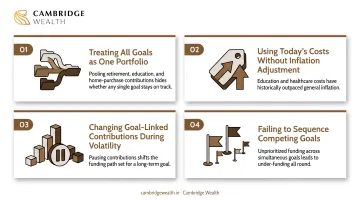
Treating all goals as one portfolio. When contributions for retirement, education, and a home purchase are pooled together with no goal-level tracking, it becomes impossible to know whether any individual goal is on track. A market correction that looks manageable at the portfolio level may represent a significant shortfall for a goal with a near-term deadline.
Using today's costs without inflation adjustment. The rupee amount required when a goal arrives is almost never the same as the rupee amount it costs today. Underestimating future cost - particularly for goals like education or healthcare, where costs have historically moved faster than general inflation - can leave a meaningful funding gap.
Changing goal-linked contributions during volatility. Reducing or stopping planned contributions during periods of market volatility changes the funding path originally established for a long-term goal. Any such decision should therefore be considered in terms of its effect on the goal's timeline and funding requirement, rather than being driven only by short-term market movements.
Failing to sequence competing goals. When investible surplus is limited and multiple goals require funding simultaneously, the absence of a priority structure leads to under-funding across the board. Some goals must be sequenced; acknowledging that explicitly allows for a more realistic and sustainable framework.
Conclusion
Defining a goal is straightforward. The more demanding work is keeping multiple investments, timelines, liquidity requirements, and changing circumstances aligned with those goals over years - through market cycles, life changes, and the natural tendency to redirect resources when short-term pressures arise.
Cambridge Wealth's Goal-Linked Approach process brings structure to that challenge. By organising each goal into a documented framework - with a defined timeline, a funding estimate, and an appropriate asset-allocation context - and by evaluating available investment products through a systematic 108-point research process across empanelled AMCs, it provides a foundation for goal-aligned scheme selection that goes beyond performance tables.
If you are managing multiple goals and want to see how a structured goal-linked approach can bring greater clarity to your investment decisions, explore Cambridge Wealth's goal-based investing approach or connect with the team to understand how Goal-Linked Approach can help organise your stated goals, timelines, and investment context.
Frequently Asked Questions
How is Goal-Linked Approach different from simply choosing investments based on returns?
A benchmark-led approach primarily evaluates investment performance relative to a market index or other performance measure. Goal-Linked Approach starts instead with the outcome the money is intended to support, along with its timeline, funding requirement, liquidity needs, and risk considerations. Investment-product information can then be evaluated within that context rather than treating return performance as the only measure of progress. Cambridge Wealth's 108-point research framework adds a structured product-evaluation process to this goal-linked approach.
Can one portfolio support several goals with different timelines?
It can, but it requires explicit structure. When contributions for goals with different timelines and risk profiles are pooled together without goal-level tracking, it becomes difficult to assess whether any individual goal is adequately funded. Cambridge Wealth's Goal-Linked Approach process organises multiple goals within a documented asset-allocation framework, so each goal's funding status can be tracked and reviewed separately - even if the practical implementation involves a relatively small number of investments.
What happens if the cost or timing of a goal changes?
Changes in goal cost or timeline are common reasons a goal-linked framework may need to be reviewed. A degree programme that now costs more than originally estimated, or a property purchase brought forward by two years, changes both the funding requirement and the asset-allocation context. Cambridge Wealth's Goal-Linked Approach process helps review whether the existing investment context still reflects the goal's updated timeline, funding requirement, and risk considerations.
How should existing investments be considered when setting up a goal-linked framework?
Existing investments are a starting point, not a constraint. The goal-linked process begins by reviewing the complete picture - current investments, their asset-allocation profile, their liquidity, and any existing commitments - and assessing how they map onto stated goals. Some existing investments will already align well with specific goals; others may need to be reconsidered in that context. The objective is to integrate existing assets into the goal-linked framework in a way that reflects each goal's actual requirements, rather than building a framework from scratch that ignores what is already in place.
How often should goal alignment be reviewed?
The appropriate review frequency depends on the goals involved and how quickly the underlying circumstances may change. A review may become particularly relevant after a significant income change, the arrival of a new dependant, or a material change in a goal's timeline or estimated cost. The purpose is to check whether the original goal assumptions and investment context still hold, rather than reacting automatically to short-term market movements.
What happens when two important goals compete for the same investible surplus?
When available investible surplus cannot support every goal at the same pace, the trade-offs need to be made explicit. The relevant considerations can include how important each goal is to you, whether its deadline is fixed or flexible, how much funding it requires, and what happens if it is delayed or scaled back. Cambridge Wealth's Goal-Linked Approach process helps organise these competing objectives within a documented framework so you can see how directing more resources toward one goal may affect progress toward another.