What it does is narrower than it is often described. It does not exempt income from tax, and it does not reduce the obligation to file in either country. It allocates the primary right to tax between the two states and relieves the overlap through a credit, so tax paid in one is set against the liability in the other rather than added to it.
This guide sets out the treaty basics, the articles that decide each income type, the withholding rates, the documents a claim depends on, and the errors that cause claims to fail.
Key Takeaways
- The US-India DTAA relieves double taxation through tax credits and defined taxing rights, not blanket exemptions.
- Coverage spans salary, dividends, interest, royalties, capital gains, pensions, and business profits.
- Claiming benefits requires a Tax Residency Certificate, Form 10F, and Form 67 (India-side).
- Compliance in both countries remains mandatory regardless of treaty relief.
What Is the US-India Income Tax Treaty?
The US-India Income Tax Treaty is a bilateral agreement that stops the same income being taxed twice—once in each country—and helps both governments curb fiscal evasion.
Its formal title is the "Convention Between the Government of the United States of America and the Government of the Republic of India for the Avoidance of Double Taxation and the Prevention of Fiscal Evasion with Respect to Taxes on Income." It was signed in New Delhi on 12 September 1989, entered into force on 18 December 1990, and took effect from 1 January 1991 for US tax purposes.
Historical and Legal Background
India's power to enter such agreements comes from Article 253 of the Constitution, which allows Parliament to legislate for implementing international treaties. The treaty’s structure follows the OECD and UN Model Tax Conventions, the templates most countries use for bilateral tax treaties.
Two points are easy to mix up:
- The 2015 FATCA agreement is a separate bilateral pact on automatic exchange of financial information, not double taxation relief.
- There is no separate US-India estate, gift, or inheritance tax treaty. The 1989 convention covers income taxes only.
Key Provisions and Articles Under the Treaty
Residency and the TRC (Article 4)
Treaty residence starts with domestic tax liability. If someone qualifies as a resident in both India and the US, the treaty applies a tie-breaker sequence:
- Permanent home location
- Centre of vital interests (personal and economic ties)
- Habitual abode
- Nationality
- Mutual agreement between tax authorities

A Tax Residency Certificate (TRC) documents this residency status for treaty administration but doesn't replace the tie-breaker test itself.
Relief From Double Taxation (Article 25)
US residents claim a credit for Indian tax paid on Indian-source income. Indian residents deduct from Indian tax an amount equal to the US tax paid, capped at the Indian tax attributable to that same income. The treaty relieves double tax through credits; it does not wipe out the underlying tax liability.
Rental Income From Indian Property (Article 6)
Rental income from immovable property is taxable in the country where the property is situated. For a US-resident owner of Indian property, that means India retains the taxing right on the rent, and the same income is also reportable in the US return with a credit claimed there for the Indian tax paid. The credit is what removes the overlap; the Indian liability itself remains.
Withholding Rates on Dividends, Interest, and Royalties
| Article | Income Type | Treaty Rate | Condition |
|---|---|---|---|
| 10 | Dividends | 15% | Beneficial owner is a company holding 10%+ voting stock |
| 10 | Dividends | 25% | All other cases |
| 11 | Interest | 10% | Paid on loans from banks or similar financial institutions |
| 11 | Interest | 15% | All other cases |
| 12 | Royalties/Fees for Included Services | 10% | Equipment royalties and related ancillary fees |
| 12 | Royalties/Fees for Included Services | 15% | Standard category (post-transition period) |
These are the rates set out in the treaty text itself, which generally cap withholding below India's domestic rates.
Pensions and the Saving Clause (Articles 19–20, Article 1(3))
Government pensions are taxable only in the paying country, unless the recipient is both a resident and national of the other country. Private pensions are typically taxable only where the recipient resides.
The Saving Clause (Article 1(3)) still lets the US tax its citizens and residents as if the treaty did not exist. Limited exceptions remain, including Social Security benefits, government-service provisions under Article 19, and student and teacher protections under Articles 21 and 22.
Who Qualifies for Treaty Benefits?
Not every cross-border taxpayer automatically gets treaty relief. Eligibility hinges on three factors:
- Tax residency status under Article 4
- Income type falling within a specific treaty article
- Valid documentation, primarily the TRC
Limitation on Benefits (Article 24)
This provision stops third-country residents from routing income through an Indian or US entity purely to claim treaty benefits. It generally requires an active trade or business connection. Passive investment holding companies generally don't qualify, unless they are run by a bank or insurer.
Special Categories
- Students and apprentices (Article 21): Exempt on funds received from abroad for education, for a reasonable training period.
- Professors and researchers (Article 22): Exempt on qualifying remuneration for up to two years of teaching or research at a recognised institution.
Cross-border eligibility rules like these rarely apply in isolation. Where someone holds US equity compensation, Indian rental income and mutual fund investments at the same time, the articles interact, and reading one in isolation produces the wrong answer on the others.
How to Claim DTAA Benefits: Step-by-Step
Claiming treaty relief isn't automatic. It requires specific paperwork, filed correctly and on time.
- Obtain a Tax Residency Certificate (TRC) from the tax authority of your resident country. This is the foundational document for any treaty claim.
- File Form 10F as a self-declaration alongside the TRC when the certificate doesn't contain all details India's tax department requires.
- Complete Schedule FSI in your Indian tax return to report income arising outside India.
- Fill Schedule TR to summarise country-wise tax relief claimed against foreign taxes.
- Disclose foreign assets via Schedule FA if you're an Indian resident holding accounts or assets abroad.
- Submit Form 67 before the return filing due date. This is mandatory for claiming foreign tax credit in India.

On the US side, you claim treaty benefits differently:
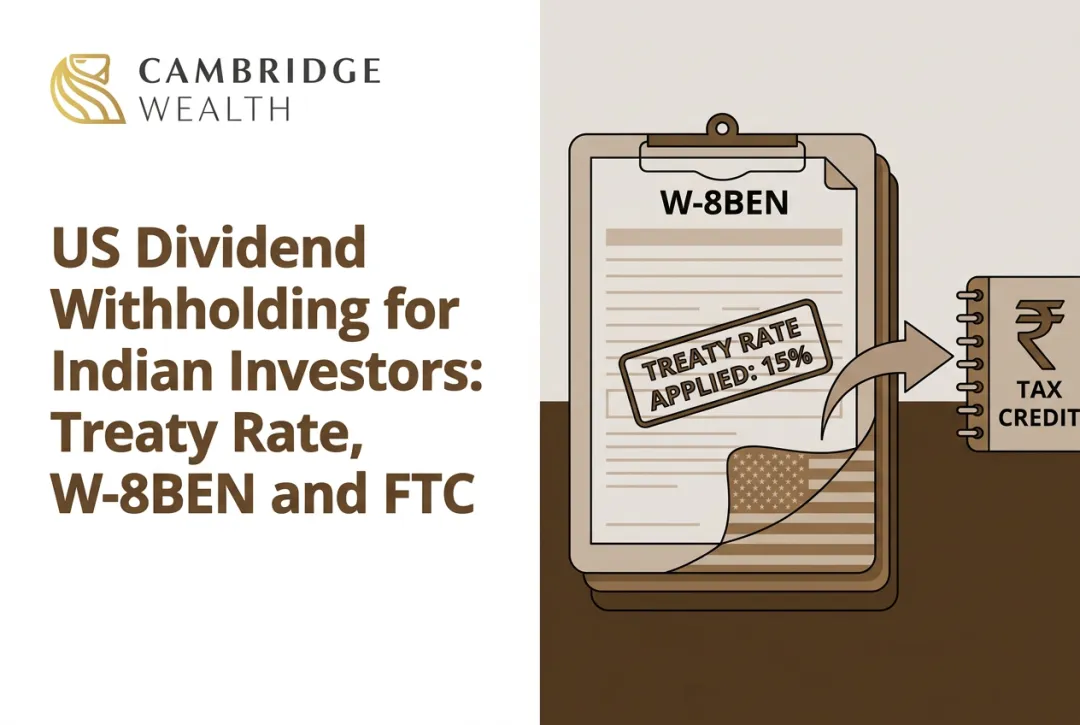
- Form W-8BEN: given to the payer (not the IRS) to certify foreign status and claim a reduced withholding rate on passive income like dividends or interest.
- Form 8233: used specifically for exemption from withholding on compensation for personal services under an applicable treaty article.
Missing any of these deadlines typically means default withholding at higher domestic rates, with the burden falling on you to claim a refund later.
Common Mistakes to Avoid When Claiming Treaty Benefits
Even well-informed NRIs stumble here. The recurring errors:
- Assuming DTAA means tax-free income. It doesn't. The treaty relieves double taxation through credits, not exemption from paying tax altogether.
- Skipping foreign asset or income disclosure. Failing to report foreign accounts on Schedule FA, or omitting foreign income from either return, invites penalties and scrutiny in both jurisdictions.
- Claiming foreign tax credit without proper proof. FTC claims without valid TRC, Form 67, or documentary evidence of tax actually paid get rejected during assessment.
- Missing India's Form 67 deadline. Filed after the due date, the whole FTC claim is at risk of denial.
Cross-border positions rarely stay static. A job change, a new investment, or a shift in residency can change which treaty article applies to the same income.
Cambridge Wealth is an AMFI-registered Mutual Fund & SIF Distributor, ARN-172841, APMI Registration No.: APRN-01683. What it can do on a question like this is support the investment-side documentation a treaty claim rests on — capital gains statements per folio, tax-residency documents and Form 10F, and records of the source of funds for each account — coordinated across the AMCs, banks and registrars that each hold part of the record. Every scheme considered for the research universe passes a documented 108-point research framework across 5,000+ Indian investment products.
Frequently Asked Questions
What is the income tax treaty between the US and India?
The US-India income tax treaty is a 1989 bilateral convention designed to avoid double taxation and prevent fiscal evasion on income taxes. It entered into force in December 1990 and has been effective since 1991.
How does the income tax treaty between the US and India prevent double taxation?
Article 25 allows taxpayers to claim a foreign tax credit for tax already paid in one country against their liability in the other. It defines which country holds primary taxing rights for specific income types.
Who qualifies for benefits under the US-India income tax treaty?
You must qualify as a tax resident under Article 4, hold a valid TRC, and meet the Article 24 Limitation on Benefits test. Passive holding structures set up purely for treaty shopping generally don't qualify.
What documents are required to claim DTAA benefits?
You'll need a Tax Residency Certificate, Form 10F (India-side self-declaration), Form 67 for foreign tax credit claims, and documentary proof of foreign tax actually paid.
Does the DTAA cover capital gains and pensions?
Capital gains are largely taxed per each country's domestic law rather than a fixed treaty rate. Pensions follow Articles 19-20, with government pensions generally taxed by the paying country and private pensions taxed in the resident's country.
Can NRIs avoid double taxation entirely under this treaty?
No. Relief comes through tax credits or defined taxing rights, not a blanket exemption. NRIs still must file returns and comply with reporting requirements in both India and the US.