Article 21 of the US-India Income Tax Treaty, titled "Payments Received by Students and Apprentices", is what changes it. Its second paragraph gives an eligible Indian student the same exemptions, reliefs and deductions available to a US resident — including the standard deduction — which is a benefit almost no other nonresident alien can claim.
This article sets out what Article 21 actually says, who qualifies, how the claim is made, and where it sits against the rest of the treaty.
Key Takeaways
- Article 21 lets eligible Indian students and trainees claim the US standard deduction, unlike most nonresident aliens
- Eligibility depends on visa type (F-1, J-1), purpose of stay, and nonresident status
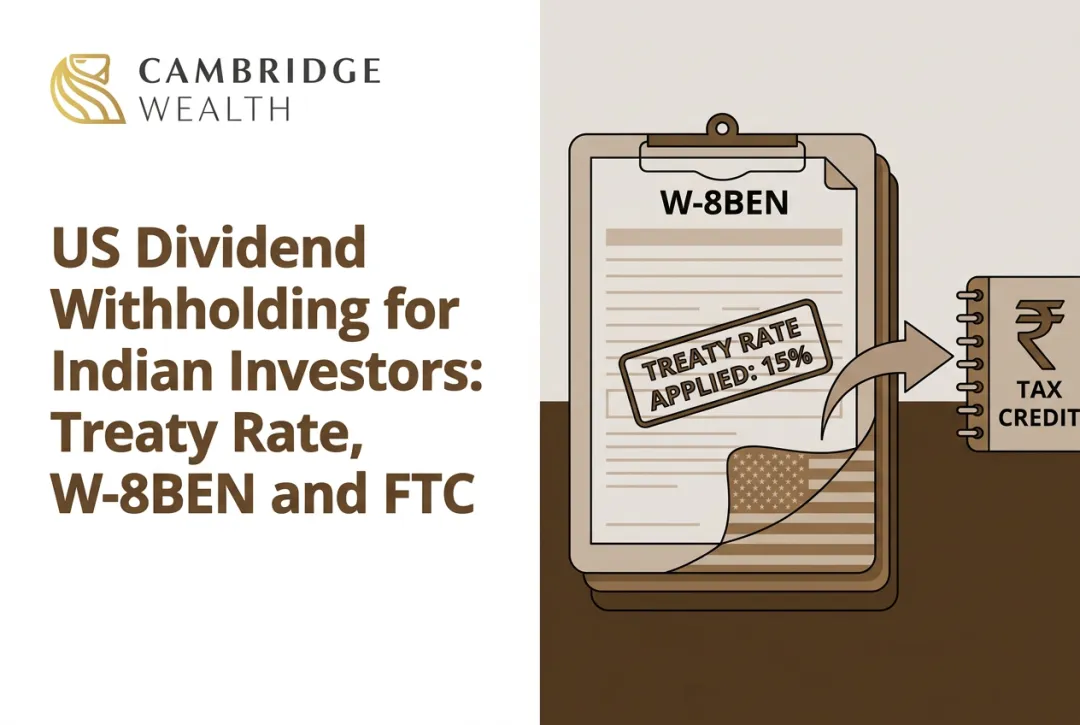
- Benefits aren't automatic — you must file Form W-8BEN or Form 8233 to claim them
- Distinct from the generic "Other Income" article found in many other treaties
- A treaty claim covers education-related income only; the rest of a cross-border position is governed by other articles
What Is the US-India Income Tax Treaty and Why Article 21 Matters
The US-India Income Tax Treaty was signed in 1989 and has been in force since December 1990, with US provisions applying from January 1, 1991. Its core purpose is to prevent the same income from being taxed twice — and to stop people from using gaps between the two tax systems to escape tax entirely.
The treaty covers a wide range of income types: dividends, interest, pensions, business profits, and personal services income. Articles are numbered sequentially, which is where confusion often starts.
Article 21 in the US-India treaty is not the "Other Income" catch-all article you'll find under that same number in many OECD-style treaties. Here, it specifically addresses payments received by students and apprentices. It sits within a family of related provisions:
- Article 19 — Government service remuneration and pensions
- Article 20 — Private pensions, annuities, alimony, and child support
- Article 21 — Payments received by students and apprentices
- Article 22 — Payments received by professors, teachers, and research scholars
Article numbering and language vary from treaty to treaty, so the operative text is the official IRS-hosted treaty document rather than a generic summary.
Article 21 Explained: Payments Received by Students and Apprentices
Article 21 has two distinct paragraphs, and mixing them up is a common mistake.
Article 21(1): Exemption on Foreign-Sourced Support
This paragraph exempts a student or business apprentice from US tax on payments that arise outside the US for maintenance, education, or training. Common examples include:
- Scholarships from an Indian institution
- Grants from abroad
- Remittances from parents back home
Where the money originates outside the US and funds education, it generally isn't taxed by the US.
Article 21(2): The Standard Deduction Benefit
This is the paragraph that changes the tax computation. It states that an Indian resident who becomes temporarily present in the US primarily for education or training is entitled to the same exemptions, reliefs, and deductions available to US residents during that period.
In practice, an Indian student on F-1/OPT status can claim the standard deduction on their US tax return, something nonresident aliens from almost every other country cannot do. Against a nonresident's ordinary position of no standard deduction at all, that shields a defined amount of income from tax before any rate is applied.
For tax year 2026, the IRS has set this at $16,100 for single filers.
One caveat: personal exemptions (the old per-person deduction) were eliminated by the 2018 tax reforms for tax years 2018 through 2025. Today only the standard deduction benefit survives, not the old exemption amount.
The Saving Clause and Why It Doesn't Block You
Most treaty benefits get wiped out by the "Saving Clause," a rule letting the US tax its own citizens and green card holders as if the treaty didn't exist. Article 21 benefits, however, are specifically carved out from this clause for individuals who are neither US citizens nor green card holders. As long as you remain a nonresident alien on a student visa, Article 21 protection stays intact.
Who Qualifies: Visa Types and Eligibility Criteria
Eligibility isn't just about holding an Indian passport. Three things must line up:
- Residency status — you must be a nonresident alien for US tax purposes
- Visa category — primarily F-1 or J-1 (student, not teacher/scholar category)
- Purpose of presence — you must be in the US principally for education or training
A few important distinctions:
- J-1 teachers and researchers fall under Article 22, not Article 21 — a two-year limit applies, and exceeding it wipes the exemption retroactively for the entire stay.
- H-1B holders who become resident aliens under the Substantial Presence Test generally lose Article 21; worldwide resident taxation replaces the nonresident-student mechanism.
Visa labels alone don't decide eligibility. The IRS tests the underlying facts: purpose of stay, residency status, and duration.

How to Claim Article 21 Benefits: Forms and Process
Article 21 benefits are not automatic. Missing the paperwork means the IRS defaults to 30% withholding, regardless of treaty eligibility.
Scholarships, grants, or investment-type income
File Form W-8BEN with the payer (university, bank, or institution) before payment is made. This certifies your foreign status and treaty claim.
Compensation from personal services
File Form 8233 with your employer for wages or internship pay. This form requires:
- Your visa type and dates of entry
- The specific treaty article being claimed (Article 21)
- A description of the income type
Your withholding agent forwards a copy to the IRS within five days of receiving it. Three filing rules follow from that:
- A separate Form 8233 is required for each tax year, each withholding agent, and each income type
- Where the form was not filed on time, the benefit is recovered by filing Form 1040-NR at year-end and reporting the treaty-exempt amount on Schedule OI
- Form 8833 is attached where the treaty position overrides standard IRC treatment
A missed form does not forfeit the entitlement permanently. It moves the recovery to tax season rather than the pay slip.

Avoiding Double Taxation: Article 21 in the Bigger DTAA Picture
Article 21 addresses one specific category: education-related income. It does not reach the rest of a cross-border position.
Article 25 (Relief from Double Taxation) works alongside it. Both India and the US use a foreign-tax-credit system, meaning tax paid in one country can generally offset tax owed in the other on the same income, subject to statutory limits.
Capital gains sit outside Article 21 entirely. Nonresident aliens present in the US for 183 days or more in a year face a flat 30% (or lower treaty rate) tax on US-source capital gains, reported separately on Form 1040-NR. This is a distinct set of rules from the wage and scholarship treatment under Article 21.
A treaty claim is therefore one article among several. The questions that follow a student visa — US income held alongside Indian investments, a return to India, assets accumulating in two jurisdictions — are governed by different articles and different domestic rules in each country.
Cambridge Wealth is an AMFI-registered Mutual Fund & SIF Distributor, ARN-172841, APMI Registration No.: APRN-01683. What it can do on a question like this is support the investment-side documentation those positions rest on — capital gains statements per folio, tax-residency documents and Form 10F, and records of the source of funds for each account — and present scheme information with holding periods and exit terms visible. Every scheme considered for the research universe passes a documented 108-point research framework across 5,000+ Indian investment products.
Frequently Asked Questions
How do I claim US-India tax treaty (DTAA) benefits, including using Form W-8BEN?
File Form W-8BEN with the payer for scholarships or investment income, or Form 8233 with your employer for compensation. If you miss the deadline, claim the benefit on your year-end Form 1040-NR instead.
How can I avoid double taxation on income between India and the US?
Article 25 allows a foreign tax credit for tax paid in one country against tax owed in the other, up to statutory limits. Records of tax paid in both jurisdictions are what support the credit claim.
Is there an income tax treaty between the US and India (US-India DTAA)?
Yes. It's been in force since December 1990, covering wages, dividends, interest, pensions, and student payments, among other income types.
What is the difference between Article 21 and Article 22 of the US-India treaty?
Article 21 covers students and apprentices with no time limit tied to duration. Article 22 covers professors and researchers, but the exemption is lost retroactively if the stay exceeds two years.
Can H-1B visa holders claim Article 21 benefits?
Generally, no. Once an H-1B holder becomes a resident alien under the Substantial Presence Test, Article 21's nonresident-student provisions no longer apply, and other treaty articles or domestic rules govern the position.
Do I need to reapply for Article 21 benefits every year?
Yes. Form 8233 must be filed for each tax year, each withholding agent, and each type of income you're claiming the exemption against.